March 30, 2022
Two Tangos, Different Charms
We often describe Latin dances like rumba, cha-cha, and samba as passionate, fiery, and sexy. Tango, however, has outgrown those labels. Today, we speak of tango in terms like elegant, graceful, and soulful—a dance that once shared the same Latin roots, but has since taken a different path. Over time, tango has been refined and gentrified, transforming from its origins in brothels into the polished art form of Tango de Salon.
Yet once upon a time, tango was that hot, sexy, passionate Latin dance.
When we compare the two forms, we notice some striking differences:
1. Tango de Salon is danced at a slower, more measured pace, while early tango was livelier and quicker.
2. In Tango de Salon, the steps are broad and expansive; in early tango, they were small and compact.
3. In Tango de Salon, the woman’s hips move in a moderate manner, staying relatively parallel to the man’s. In early tango, her hips moved more freely, often creating a striking contrast—sometimes perpendicular to the man’s stance.
4. Tango de Salon emphasizes elegance and harmony between partners. Early tango leaned into bold expressions of gender identity and sensual tension.
5. Tango de Salon focuses on subtle, inward feeling. Early tango emphasizes dramatic visual flair.
Both styles have their own allure—one radiates maturity and refinement, the other bursts with energy and passion.
The fact that earlier tango has largely disappeared, to me, is something of a loss. I believe it still holds aesthetic value. Its techniques—as the couple in the video below attempts to recreate—are worth revisiting and studying.
But the evolution of human aesthetics follows its own logic, one that transcends personal preference. Perhaps, as a general rule, the idea that "Elegance is the only beauty that never fades," as Audrey Hepburn once said, explains tango’s transformation. Passion may burn brightly and then fade—but elegance, it seems, endures. (See Embracing Elegance.)


February 22, 2022
Dance Like Milongueros
Novice dancers frequently become preoccupied with the mere execution of steps, often neglecting the equally important aspects of musicality and choreography. However, the artistry of tango lies more in musicality and choreography than in vocabulary. To truly grasp this, let's explore how the milongueros approach their dance.
What sets the milongueros apart is not the complexity of their steps, but their remarkable musicality and choreography, which are characterized by several key qualities:
1. Milongueros dance at a slower pace, enabling their partners to follow with grace and elegance.
2. Each step is thoughtfully crafted and clearly led, focusing on conveying the music and emotions rather than mere showmanship.
3. Pauses are incorporated to articulate phrasing, shape intention, and enrich the rhythmic variations of the dance.
4. These pauses are not static, but contain subtle movements that grant the follower space for personal expression and embellishment.
5. Their movements are pulsating, resembling the ebb and flow of waves, which facilitates cadencia—the swing of the body that adds elegance to their dance.
6. Transitions between steps are seamless, often including pivots that prepare for subsequent movements in different directions.
7. The cycle of surging steps, pauses, smooth transitions, and additional surges creates a rhythm that deeply resonates with the music and emotions inherent in social tango.
This approach stands in stark contrast to the hurried, beat-chasing style often seen in contemporary tango. Many dancers prioritize movement over musicality and choreography, resulting in a dance that resembles gymnastics—robotic and relentless, rather than rooted in emotional expression. A common tendency is to dance in a monotonous or mechanical pace that limits the potential for deeper, expressive artistry. What's missing are those crucial elements of pause, softness, and subtlety—those quiet moments where emotional connection can truly flourish.
Consider the following example.
These dancers appear compelled to step on every beat—without musical interpretation, without expressive nuance, without pause, slow motion, or subtle movements. And yet, they are not beginners. Their technical proficiency exceeds the average found online. I chose this clip to illustrate a crucial point: vocabulary, musicality, and choreography are distinct skills. Most dancers possess the first, but fall short in the latter two.
Cultivating pauses, slow motion, subtlety, and emotional depth within choreography does take time, yet this is precisely what we can learn from the milongueros. The dancers in the next clip have begun to internalize this lesson—and their progress is evident.
Many of them have started to adopt the style of the milongueros. A standout example is the man in the hat who appears between 3:10 and 3:50. By incorporating more pauses and slow motions into his choreography, he prevents his dance from slipping into mechanical repetition and transforms it into a richer, more flavorful experience. Pauses and slow motion in tango are like punctuation in writing—they elevate musicality, meaning, and allure of the dance (see Floorcraft, Choreography, and Musicality).
Here is another good example:
Dancing tango requires patience; it cannot be rushed. The integration of suspension, pauses, deliberate slowness, and musical interpretation transforms tango from mere physical activity into a beautiful form of expressive art. Aspiring dancers should not overlook the significance of musicality and choreography—these elements are just as crucial as vocabulary and merit equal attention on the dance floor. Learn from the milongueros to allow your tango to evolve into a meaningful and expressive experience. (See Pauses: Tango’s Most Underestimated Technique.)
January 7, 2022
Tango in Small Cities
In Chengdu, China, teahouses dot the streets and alleys, each one brimming with life. More than just places to drink tea, they serve as lively social hubs where locals gather to spend time together: converse, read, play chess, enjoy traditional opera, and more. This unhurried ritual is deeply ingrained in the daily rhythm of Chengdu life.
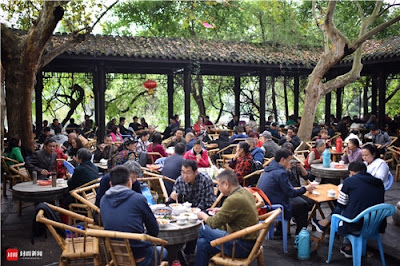
Similarly, in Buenos Aires, the milonga holds a special place in the hearts of its people. Just as teahouses are to Chengdu, the milonga is a cherished cornerstone of local culture. Scattered throughout the city, these venues are where Porteños meet friends, sip coffee, listen to music, and dance tango. Over time, many become skilled dancers, and tango become an essential part of their daily lives. For countless Porteños, a day without tango feels incomplete.
However, tango dancers in smaller cities aren’t as fortunate. With too few dancers to sustain regular milongas, they face unique challenges. I know this struggle firsthand—I used to drive to nearby cities to dance tango. A three-hour milonga often meant five hours on the road. The sleepless nights, fatigue, and mounting costs eventually took their toll, forcing me to adjust to the reality of dancing locally.
Dancing locally may not offer the same thrill as big-city milongas, but it brings convenience, affordability, and sustainability. While occasional trips to larger cities can be enriching, tango aficionados in smaller towns must recognize the value of cultivating a local scene. In major cities, established tango communities provide structure and support, but in small towns, that responsibility falls on us. Building a tango community is no easy feat, yet it is essential. If we rely on long-distance travel, exhaustion or life circumstances will eventually catch up with us, leaving tango out of reach. Instead of waiting for that day, why not invest our energy into creating a thriving local community—one that allows us to enjoy tango just as dancers in larger cities do?
Dancers in small towns must adopt a strategic mindset. We can’t wait for others to create opportunities for us—we need to take initiative, plant seeds, and tend them until they grow. Building a tango community takes time, patience, and effort, but the investment pays off. Don't be afraid of starting small and slow, as long as we stick to the cause, the start-up phase will pass. With time, we will grow stronger. Instead of seeking dance elsewhere, our focus should be on improving our local group.
The importance of building a local tango group cannot be overstated. It’s not just where we hone our technique—it’s where we form the bonds that make tango truly special. Tango is a fellowship, a shared experience. Without a team, there is no tango. While it’s tempting to seek out more established communities, why not invest in our own? As dancers, we must think not only about the present but also about the future. Let’s prioritize team-building alongside personal enjoyment and aim to contribute as much as we receive. I willingly provide a place for our group to dance as my contribution, but I hope others will also step up—not as a favor to me but as a way to strengthen our community. Don’t come just for the fun. Ask yourself: “What have I done for the group lately?” If everyone plays their part, our local tango community will flourish. And one day, tango will become an indispensable part of our daily lives as well (see Never Forget Why We Started.)
December 9, 2021
Democracy vs. Plutocracy
American political thought is fundamentally atomistic, rooted in the belief that individuals are autonomous beings endowed with inalienable rights to pursue their own self-interest. This philosophical foundation normalizes intense competition, where a few emerge as winners while the majority are left behind. Those who succeed in this system often consolidate their power by forming political parties, which claim to represent the public but primarily compete for influence and control.
Elections serve as the formal mechanism through which these parties alternate power. Over time, practices such as political donations, lobbying, and media campaigning have been redefined as forms of free speech, allowing those with greater resources to dominate the political arena. As a result, elections become increasingly ideological and media-driven, shaped by those who have the means to sway public opinion. Ultimately, this dynamic fosters a political landscape in which policies tend to favor the wealthy, deepening social and economic inequality.
With elections increasingly vulnerable to financial influence, misinformation, and character attacks, American politics has become deeply contentious. Elected officials often prioritize performative rhetoric and media attention over effective governance, focusing more on pleasing donors and securing re-election than advancing the public good. The frequent shifts in party control lead to erratic policy reversals, undermining long-term planning and institutional stability. Each administration tends to overspend, accumulate debt, and resort to printing money to inflate short-term approval—leaving the economic consequences to future governments. Meanwhile, partisan gridlock paralyzes decision-making and intensifies social division.
Despite these dysfunctions, many Americans still regard the current system as the only legitimate form of democracy. In practice, however, the U.S. political system operates more as a partisan democracy than a people’s democracy. Increasingly, scholars argue that it has morphed into a plutocracy—rule by the wealthy and well-connected. Nobel laureate Joseph Stiglitz famously characterized the United States as a nation “of the 1%, by the 1%, and for the 1%.” Backed by powerful special interests, political elites often sideline the needs and voices of the broader population.
The consequences of this distorted system are stark. The U.S. has the highest levels of inequality among developed nations, and during the COVID-19 pandemic, it suffered a death toll over 170 times higher than China’s and an infection rate 1,600 times greater. Decades of financial mismanagement have pushed the national debt beyond $30 trillion, much of it channeled into private contractors, defense budgets, and corporate subsidies. Meanwhile, deep-rooted social problems—ranging from racial conflict and poverty to drug addiction and gun violence—continue to plague the nation.
With less than a quarter of the population of China or India, the U.S. nonetheless has the world’s largest prison population. Its healthcare system is the most expensive globally, yet millions remain uninsured or underinsured. Retirement ages have steadily climbed, placing increasing burdens on the elderly. According to the U.S. Life Insurance Guide, the average retirement age is 67.9 for men and 66.5 for women, compared to China’s 60 for men, 55 for women. Public education is in decline, infrastructure is aging, and the country has been at war for 229 of its 245-year history. These conflicts, often justified in the name of “American values,” perpetuate high military spending, weapons exports, and global dominance—primarily serving entrenched economic and political interests.
Although this system is labeled a democracy, the average American has increasingly little influence over the decisions that shape their daily lives.
In contrast, Chinese political thought is fundamentally holistic, emphasizing the interdependence of individuals within the broader social fabric. Human rights in China are framed in terms of collective well-being rather than individual autonomy. These rights encompass not only personal freedom but also values such as coexistence, equality, cooperation, and social harmony. Whereas American thought tends to view individuals as independent actors pursuing self-interest, Chinese thought sees people as intrinsically connected, with mutual obligations to family, community, and society. Rooted in Confucian tradition, this perspective prioritizes ethical behavior, consensus-building, and the pursuit of communal interests as essential to maintaining social stability and order. (See Understanding China: Geography, Confucianism, and Chinese-Style Modernization.)
China adopts a model of people’s democracy, prioritizing collective governance over partisan competition. While individual interests vary, leadership is expected to represent the broader will of the population. With a 5,000-year tradition of governance, China has historically recognized both the risks of factionalism and the importance of unified political leadership. The Communist Party of China (CCP), comprising nearly 100 million members, positions national interest above partisan agendas. Leadership selection occurs every five years through the CCP National Congress and the National People’s Congress, with candidates evaluated based on character, competence, and proven achievement, rather than rhetoric or ideology. Policy development involves extensive research, public consultation, and meticulous planning to balance short-term priorities with long-term national goals. Unlike the U.S., where governance often reflects special interest influence, China’s system seeks to foster a just and harmonious society rooted in shared prosperity. Institutional safeguards—including collective leadership, term limits, anti-corruption measures, public supervision, and internal discipline—aim to enhance accountability and prevent authoritarianism.
Differences in human rights perspectives shape how each country approaches key issues. In the U.S., COVID-19 precautions were largely seen as a matter of personal choice, with individual liberty prioritized over collective protection. In contrast, China placed public health first, with temporary restrictions widely accepted for the greater good. Similarly, Americans often view gun control as an infringement on personal freedom, whereas the Chinese regard strict firearm laws as essential for public safety. In the U.S., business regulation is frequently seen as a constraint on economic freedom, while in China, such oversight is viewed as necessary to reduce inequality. Intellectual property in the U.S. is tightly protected, often limit accessibility and innovation, while China promotes shared technological advancement to accelerate national development. And while the U.S. frequently invokes individual rights to justify foreign interventions, China considers such actions—including the instigation of color revolutions and conflicts under the banner of democracy—as violations of national sovereignty and human rights.
No political system is immune to failure. History teaches that if a nation fails to confront its ideological, institutional, and systemic flaws, decline is inevitable. The dominance of special interests—such as corporate lobbies and the military-industrial complex—erodes democratic legitimacy and public trust. Drawing from China’s long history, the collapse of a democracy under the weight of corruption and plutocracy may take less than three centuries (see Understanding China: The Vicious Circle of Regime Change). This is why Chinese political culture values collectivism and egalitarianism over individualism. As China rises, Confucian values are poised to play a larger role in shaping global political thought—an evolution worth noting and, perhaps, celebrating. (See Pluralism vs. Monism.)
November 30, 2021
The Cradle Effect
The warm embrace, captivating music, and rhythmic motion of the milonguero tango can lull a woman into a dreamlike state—much like a baby gently rocked to sleep in a cradle. This sensation can be so profound that, when the tanda ends, she may be reluctant to wake. I refer to this magical experience as “the cradle effect” (see Tango Is a Feeling).
At the beginning of a tanda, a woman may maintain some distance, especially if she’s unfamiliar with her partner. However, an experienced leader knows how to ease her into the dance, dissolve any hesitation, and invite her into a state of full immersion. Here are four keys to creating that experience:
1. Offer a Comfortable Embrace
The first key is to provide a cozy embrace—her cradle within the dance. Your hold should be gentle, tender, affectionate, and comfortable, fostering a sense of security without confinement. Allow her the space she needs, but strive to lead with your torso rather than your arms or hands. As she begins to follow your torso, her focus will shift from executing steps to fully absorbing the sensation. This transition elevates the movement from mechanical to emotional. (See The Heart of Tango: Mastering the Embrace.)2. Engage Her with the Music
The second key is to immerse her in the music—to mesmerize her with the melodies, so to speak. When you dance with the music rather than simply executing steps, you invite her to move from technical precision to a deeper connection with the melody and you. To achieve that, you must express the music in your unique way. If your movements are mechanical, stepping to every beat without nuance, she will likely mirror that rhythm without truly listening. However, when your movements reflect your personal interpretation, she can surrender to the moment and experience the music through you. Here, the quality of the music plays a critical role—but that is in the DJ’s hands. Dancers can only make the most of what is provided. (See My Two Cents on Music Selections.)3. Keep the Steps Simple
The third element is to keep the steps straightforward, allowing her to focus fully on the music and emotions rather than straining to execute complex movements. Avoid flashy or intricate choreography—the goal is not to impress but to enchant and mesmerize. Complicated figures can be distracting, making it difficult for her to surrender to the experience. In contrast, natural and simple movements foster an environment where she can let go effortlessly. (See Natural Movement Reigns Supreme Over Affected Mannerism.)4. Dance at a Slower Pace
Finally, resist the temptation to chase the beat. It’s hard to find relaxation when feeling rushed or excited. Instead, dance at a slower pace, incorporating smaller steps, gentle movements, slow motions, pauses, and suspensions. The goal is to create an atmosphere where your partner can enjoy the music and the rhythmic movement while remaining relaxed, effortless, and almost in a hypnotic state. When you notice her soften, release resistance, and fully yield to the dance, she has truly entered that state.On her part, all she needs to do is surrender and relax—letting go of ego, independence, and the impulse to perform. Instead, she should focus on the embrace, the connection, the music, the feeling, the synchronization, and the sensation of becoming one with her partner. Women, by nature, tend to be more emotionally attuned, intuitive, and responsive to the hypnotic pull of music, which may explain tango’s particular allure for them.
That said, the cradle effect isn’t exclusive to women. Men, too, long to be enveloped in a woman’s warm embrace. When both partners understand how to cultivate this experience together, the dance transforms into something mesmeric, intoxicating, and unforgettable.
Subscribe to:
Posts (Atom)